
Key Takeaways
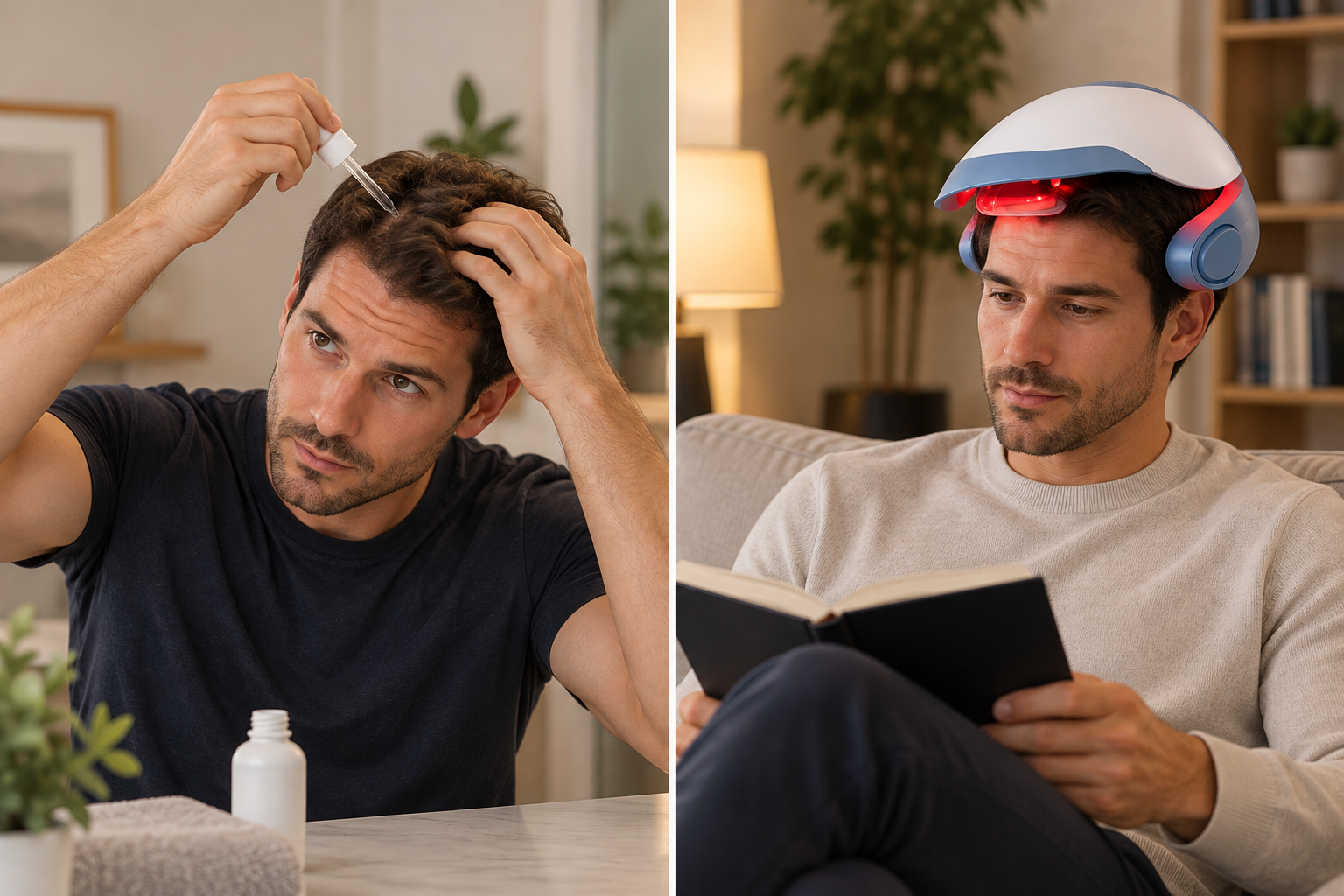
Both treatments target the same problem from opposite directions. Minoxidil is a topical drug applied to the scalp daily, while red light therapy is a device used for short sessions a few times a week, and the two act on entirely different parts of the hair growth cycle.
Choosing between them is less a question of which is stronger than of which trade-off suits the person making the choice. Both have randomized trials behind them, and neither has been shown to beat the other, so what actually separates them is a daily application with side effects attached on one side, and short weekly sessions with almost none on the other.
How Red Light Therapy and Minoxidil Work Differently
Minoxidil is a topical drug that can stimulate hair growth and prolong the growth phase of the hair cycle. Its exact mechanism is not fully understood, but it affects several cellular pathways involved in follicle activity.
Red light therapy works through cellular energy rather than circulation. Red and near-infrared wavelengths are absorbed by cytochrome c oxidase in the mitochondria of cells in and around the follicle, more energy becomes available for the work those cells already do, and follicles in a dormant state are prompted back toward active growth.
Neither addresses the underlying cause of pattern hair loss, which is worth saying at the outset. Androgenetic alopecia is driven by follicle sensitivity to dihydrotestosterone, and a drug that blocks that hormonal pathway is a different category of treatment from either of these, which is why both are usually described as treatments that slow and partially reverse rather than cure.
Is Minoxidil More Effective Than Red Light Therapy?
Neither has been shown to beat the other, and the reason is that very few trials have tested them against each other under the same conditions. Both are supported by randomized controlled trials in pattern hair loss, both carry FDA status for treating it, and the American Academy of Dermatology lists topical minoxidil and at-home laser devices alongside each other as treatments for male pattern hair loss rather than ranking one above the other.
Minoxidil’s literature is the longer-running of the two, while the research on light therapy has caught up quickly and now includes meta-analyses rather than only individual trials. Treating decades of use as proof of superiority confuses how long a treatment has existed with how well it works, which are separate questions.
Where the evidence does point somewhere definite is on using both. A 2025 systematic review and meta-analysis of seven randomized trials found that light therapy combined with topical minoxidil outperformed minoxidil on its own, with a greater increase in hair density, a greater increase in hair diameter, and higher patient satisfaction, at no cost in adverse events. The strongest finding in this comparison is therefore not that one wins, but that minoxidil alone is beaten by minoxidil plus light.
Red Light Therapy vs Minoxidil Results Timeline
Both work slowly, and both ask for a commitment measured in months before any judgment is possible.
| Red light therapy | Minoxidil | |
|---|---|---|
| First visible change | 3 to 4 months | 3 to 6 months |
| Peak result | 6 to 12 months | 6 to 12 months |
| Commitment per week | 3 to 4 short sessions | 7 daily applications |
| Randomized trial support | Yes, including meta-analyses | Yes, over a longer period |
| Initial shedding phase | None documented | Common, 2 to 8 weeks |
| Needed to hold results | Continued use | Continued use |
Four months is the earliest point at which either treatment is worth assessing, since the hair growth cycle itself sets the pace and no intervention can shorten it. AAD guidance puts the minoxidil window at six to 12 months before results show, which makes anything abandoned at six weeks a treatment abandoned before it had a chance to show anything.
Side Effects of Minoxidil vs Red Light Therapy
The difference here is substantial, and it is the clearest practical reason people choose one over the other.
Minoxidil
Scalp irritation, itching, and headaches are the effects the AAD lists, which also notes that the foam formulation appears to carry a lower risk of an irritated scalp than the liquid, since the propylene glycol in liquid versions contributes as much as the drug itself. Unwanted hair growth on the face can occur where the solution runs or transfers, and the drug is absorbed systemically to a small degree, so anyone with a cardiovascular condition should raise it with a doctor rather than starting unsupervised. Minoxidil is not considered appropriate during pregnancy.
Red Light Therapy
Reported effects are minimal at the doses consumer scalp devices deliver. Mild warmth during a session and occasional scalp tenderness are the usual extent of it, there is no systemic absorption because nothing is applied, and no drug interaction to consider. Anyone taking a medication that increases light sensitivity, or with a scalp condition currently flaring, should check before starting.
Daily versus weekly matters as much as the side effect profile. A treatment applied every day for years has more opportunities to irritate than one used for a few minutes several times a week, and adherence tends to follow tolerability.
Does Minoxidil Cause Shedding When You Start?
Shedding in the first weeks of minoxidil is well documented and expected. The drug pushes follicles out of their resting phase and into a new growth cycle, and a hair already sitting in a resting follicle is displaced as the new one begins, which produces a temporary increase in hairs lost before the count improves.
Two to eight weeks is the usual window, and it resolves on its own. Understanding this before starting is what prevents people from stopping at the exact point the treatment began working, which is the most common reason minoxidil gets written off as ineffective.
Red light therapy has no equivalent phase. Nothing about increasing cellular energy availability forcibly ejects resting hairs, so there is no documented initial shedding period, and this is a genuine point of difference rather than a marketing claim. Anyone who finds the prospect of a visible shed unacceptable has a reason to prefer the device.
What Happens If You Stop Minoxidil or Red Light Therapy?
Neither treatment holds its results after it stops, and this is the point both are most often sold without. AAD guidance on minoxidil is direct about it, noting that once treatment stops, some hairs look thinner and shedding gradually increases, since the drug had been holding follicles in a growth phase they would not otherwise have sustained.
Light therapy fades on the same principle over a longer timeframe. The increased cellular activity it supported returns to baseline once sessions end, and the hair that activity maintained thins again gradually rather than falling out in a defined window.
Both are therefore ongoing commitments rather than courses of treatment, which should be factored into the decision before either is started. The device is the easier commitment to sustain over years, and a daily application is the easier one to abandon.
Can You Use Red Light Therapy and Minoxidil Together?
Combining them is common, and the reasoning behind it is sound. Minoxidil acts on circulation and the growth cycle, light therapy acts on cellular energy within the follicle, and two different mechanisms targeting the same structure are more plausibly additive than redundant.
Measured outcomes back this up rather than mechanism alone. The 2025 meta-analysis of seven randomized trials found the combination ahead of minoxidil by itself on hair density, hair diameter, and patient satisfaction, and a separate randomized trial in female pattern hair loss reported greater gains in hair diameter from adding a 655nm laser helmet to 2% minoxidil over 24 weeks, though its results across other measures were mixed rather than uniformly better.
Sequencing is the one practical consideration. A session on a dry scalp before applying minoxidil avoids treating through a layer of product, which would absorb some of the light before it reached anything, and applying the drug afterward lets it stay on the scalp undisturbed for the hours it needs. Adding both on the same day from the start also removes any way of telling which one caused an improvement or a reaction, so introducing them a few weeks apart is worth the delay for anyone with a sensitive scalp.
Cost of Red Light Therapy vs Minoxidil Long Term
Minoxidil looks cheaper and stops looking cheaper with time. A month of generic topical minoxidil costs very little, but the cost never ends, because stopping means losing the result, so the real figure is a small monthly amount multiplied by however many years the treatment continues.
A device is the opposite shape. One payment covers it, there is nothing to reorder, and the cost per session falls for as long as the device keeps working, which makes the comparison a question of where the crossover point sits rather than which is cheaper outright.
Several years is the usual answer, and it is shorter than most people expect once the arithmetic is done. Someone who expects to treat hair loss for a decade is comparing a one-time purchase against a recurring expense that runs the whole decade, and the convenience difference points the same way as the money.
Red Light Therapy Device for Hair Growth
Coverage is what separates scalp devices from each other, more than any specification. A handheld unit treats a small area at a time and depends on the user moving it accurately across a scalp they cannot see, which produces uneven dosing across exactly the areas that matter most.
The Artemis LED Hair Crown is built around that problem, covering the full scalp in a single session so the delivered dose does not depend on technique, and pairing laser diodes with LED red light so both emitter types contribute to the same treatment. Sessions are short, and the schedule is a few times a week, which is the pattern the research on this application is built on and a far lighter commitment than a daily topical.
Nothing about it rules out minoxidil alongside it, which is the practical point for anyone weighing the two. A device bought once can sit alongside a drug, replace a drug that proved intolerable, or carry the result on its own if the daily routine stops being realistic.
Conclusion: Red Light Therapy or Minoxidil for Hair Loss
Neither treatment has been shown to outperform the other, and anyone presenting one as the obvious winner is going beyond what the trials support. Both have randomized evidence behind them, both are recognized treatments for pattern hair loss, and the handful of direct comparisons is too small to settle it either way.
What separates them in practice is what each asks of the person using it. Minoxidil means a daily application for as long as the result is wanted, scalp irritation as the common complaint, a shedding phase in the first weeks, and a cost that recurs indefinitely. Light therapy means a few short sessions a week, minimal side effects, no initial shed, and one payment, which is the easier commitment to hold for years.
Using both is the best-supported option of the three, and that is the clearest thing the evidence says: the combination beat minoxidil alone across seven randomized trials, with no increase in side effects. Whichever route is taken, four months is the minimum before judging it, and both stop working when they stop being used, so the decision comes down to which commitment can be kept.