
Key Takeaways
- •Forehead lines are caused by frontalis muscle contractions combined with collagen loss.
- •Horizontal lines and vertical frown lines (the 11s) require different treatment approaches.
- •Botox is the most effective treatment for dynamic forehead lines.
- •Topical retinoids can soften static lines over 3-6 months.
- •Forehead patches may temporarily smooth lines through hydration and compression.
- •Excessive Botox in the forehead can cause a 'frozen' look or brow ptosis.
Understanding Forehead Lines
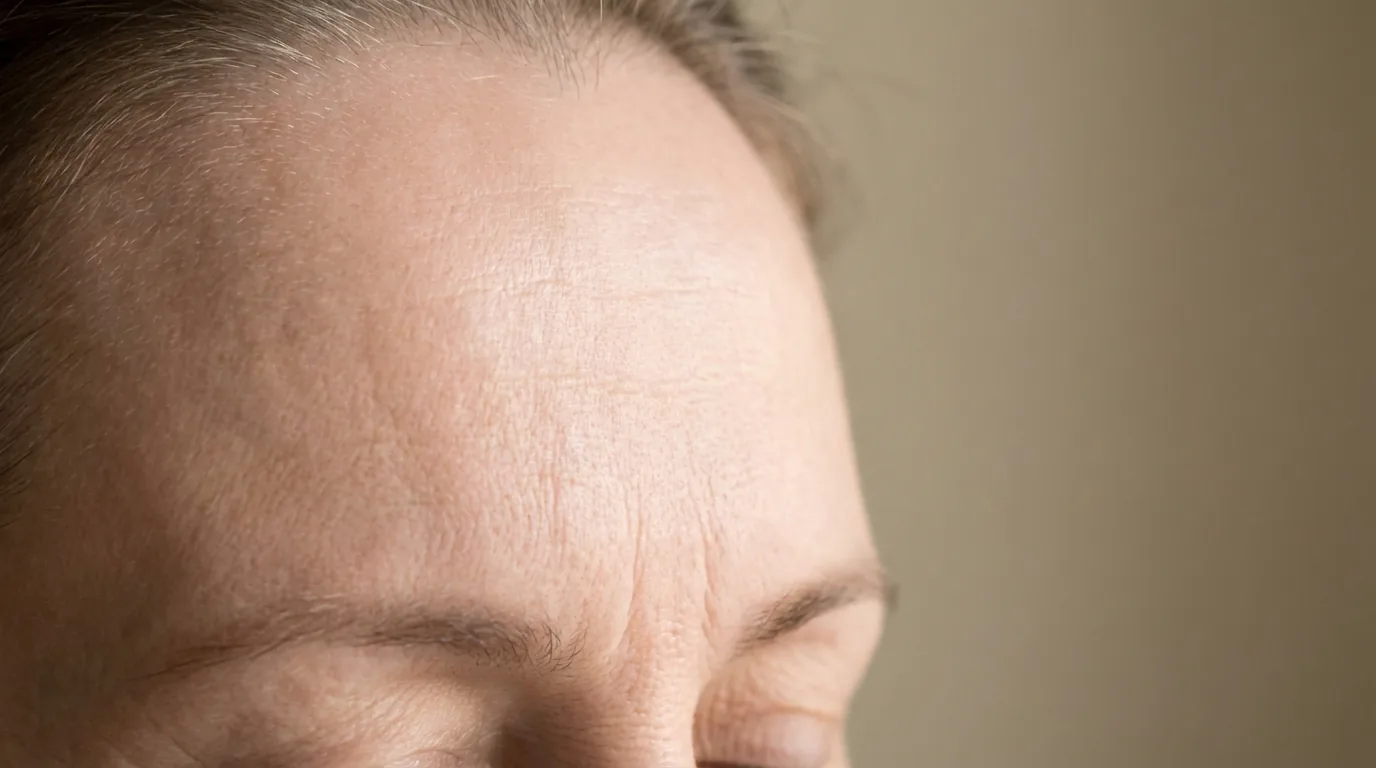
Forehead lines come in two distinct varieties, each with different causes and treatment approaches. Horizontal forehead lines run across the forehead and are created by contractions of the frontalis muscle — the broad, flat muscle that raises the eyebrows. Every time you raise your eyebrows in surprise, attention, or emphasis, the frontalis contracts and folds the overlying skin into horizontal creases.
Vertical frown lines — commonly called the 'elevens' or glabellar lines — appear between the eyebrows and are created by the corrugator supercilii and procerus muscles. These muscles draw the eyebrows together and downward, as when you frown, concentrate, or squint. The resulting vertical creases can create an inadvertently angry or worried appearance, which is why they're among the most commonly treated facial wrinkles.
Like all expression lines, forehead wrinkles progress from dynamic (visible only during movement) to static (visible at rest) as the skin gradually loses its ability to spring back after being folded. This transition typically begins in the late 20s to early 30s and is accelerated by UV exposure, genetic predisposition, and habitual expressions. People who are particularly expressive — actors, teachers, animated conversationalists — tend to develop deeper forehead lines earlier.
The severity of forehead lines is also influenced by skin thickness and hydration. Thinner, drier skin shows expression lines more prominently than thicker, well-hydrated skin. This is why forehead lines often appear worse in winter months when indoor heating dehydrates the skin, and why adequate moisturization can meaningfully reduce their visibility.
At-Home Topical Treatments
Retinoids remain the most effective topical approach for reducing the appearance of forehead lines. By stimulating collagen production and increasing epidermal thickness, retinoids improve the skin's resilience and its ability to resist creasing. Apply your retinoid across the entire forehead in the evening, using the same concentration you use on the rest of your face. Visible improvement in line depth typically appears after 8-12 weeks of consistent use.
Peptide serums — particularly those containing argireline (acetyl hexapeptide-3) — may provide modest benefits for expression lines. Argireline works by inhibiting SNARE complex formation, which is part of the neurotransmitter release mechanism at the neuromuscular junction. While far less effective than Botox, some studies show measurable reduction in wrinkle depth with consistent application.
The Frownies Facial Patches have maintained popularity for decades as a non-invasive option for forehead lines. These adhesive patches physically hold the skin flat during sleep, preventing the unconscious muscle contractions that deepen forehead lines overnight. While they don't address the underlying cause, regular use can produce temporary smoothing effects that some users find meaningful. The Neutrogena Rapid Wrinkle Repair line provides retinol in an accessible, well-formulated product suitable for forehead application.
Hyaluronic acid serums provide immediate (though temporary) improvement by plumping surface cells and filling in fine lines from above. Look for products containing both high and low molecular weight hyaluronic acid — the high molecular weight sits on the surface for immediate plumping, while the low molecular weight penetrates to provide deeper hydration.
Professional Treatments
Botulinum toxin (Botox, Dysport, Xeomin) is the gold standard treatment for forehead lines. For horizontal lines, Botox is injected into the frontalis muscle at multiple points across the forehead, reducing the muscle's contraction strength and preventing the folding that creates horizontal creases. For glabellar lines, injections target the corrugator and procerus muscles. Results appear within 3-7 days and typically last 3-4 months.
Proper Botox technique in the forehead requires skill and restraint. Over-treating the frontalis can cause a 'frozen' appearance where the patient cannot raise their eyebrows, or worse, brow ptosis (drooping) where the heavy brow descends without the frontalis to hold it up. An experienced injector uses the minimum effective dose and considers the patient's unique anatomy, muscle strength, and aesthetic goals.
For those looking to avoid injectables, red light therapy has clinical backing for reducing the appearance of expression lines through collagen stimulation and improved skin elasticity. While not as immediately dramatic as Botox, consistent use of red light therapy can support the skin's structural integrity in the forehead area, potentially slowing the progression from dynamic to static lines.
Microneedling and fractional laser treatments stimulate collagen production in the forehead area, improving the skin's resilience and reducing the depth of static lines. These treatments work best for lines that are visible at rest — they don't affect muscle movement and therefore won't prevent dynamic lines from forming during expression. Combining these treatments with Botox provides both dynamic and static line improvement.
Prevention Strategies
Sunglasses reduce forehead lines indirectly by eliminating the squinting reflex that engages the forehead muscles. When you squint, the frontalis, corrugator, and procerus muscles all engage, accelerating line formation. Quality sunglasses worn consistently in bright conditions reduce this habitual muscle engagement.
Awareness of habitual expressions can help reduce unnecessary forehead muscle engagement. Many people raise their eyebrows during conversation, while reading, or when concentrating — often without realizing it. Simply becoming aware of these patterns and consciously relaxing the forehead muscles can reduce the cumulative folding that creates forehead lines.
Sun protection is critical for the forehead, which receives significant direct UV exposure throughout the day. The forehead is one of the most sun-exposed areas of the face and accumulates UV damage rapidly. Daily SPF 30+ application, combined with hat-wearing during extended sun exposure, protects the collagen and elastin that maintain forehead skin's resilience.
Adequate hydration and moisturization keep forehead skin supple and less prone to visible creasing. Dehydrated skin shows expression lines more prominently because the surface cells are shrunken and the natural plumping effect of hydration is absent. A hydrating serum under your moisturizer can make a meaningful difference in how pronounced forehead lines appear.
When to See a Professional
If topical treatments and lifestyle modifications haven't produced satisfactory improvement after 3-6 months, a consultation with a cosmetic dermatologist or experienced injector is the logical next step. They can assess whether your lines are primarily dynamic (best treated with Botox), static (better addressed with fillers, lasers, or microneedling), or a combination of both requiring a multi-modality approach.
First-time Botox patients should seek a board-certified dermatologist or plastic surgeon with extensive experience in facial injection. The forehead requires careful assessment of muscle strength, brow position, and facial proportions. An overly aggressive approach can produce unnatural results that take months to resolve.
For deep, established static forehead lines that haven't responded to other treatments, a combination of Botox (to stop further deepening) plus hyaluronic acid filler or biostimulator injections (to address existing volume loss in the crease) may be recommended. This combination approach addresses both the cause and the consequence of forehead wrinkling.
Annual or biannual maintenance is typical for those who begin professional treatment. Many patients find that consistent Botox use over time actually reduces the dose needed, as the muscles gradually weaken from prolonged disuse. This phenomenon, sometimes called 'preventive Botox,' means that starting treatment earlier may produce better long-term results with lower doses.
References
- Carruthers A, Carruthers J. "Botulinum toxin type A for the treatment of glabellar rhytids." Dermatologic Surgery. 2005;31:489-494.
- Blanes-Mira C, et al. "A synthetic hexapeptide (Argireline) with antiwrinkle activity." International Journal of Cosmetic Science. 2002;24(5):303-310.
- Raspaldo H. "Volumizing effect of a new hyaluronic acid sub-dermal facial filler on half-face treatment." Journal of Cosmetic and Laser Therapy. 2008;10(3):134-139.
Related Articles
Crow's Feet: What Works and What Doesn't
January 20, 2025

The Real Difference Between Fine Lines and Deep Wrinkles
February 17, 2025
Botox vs. Fillers: What Actually Makes You Look Older Faster
February 14, 2024

How Retinol Actually Works (And Why Most People Use It Wrong)
January 15, 2020