
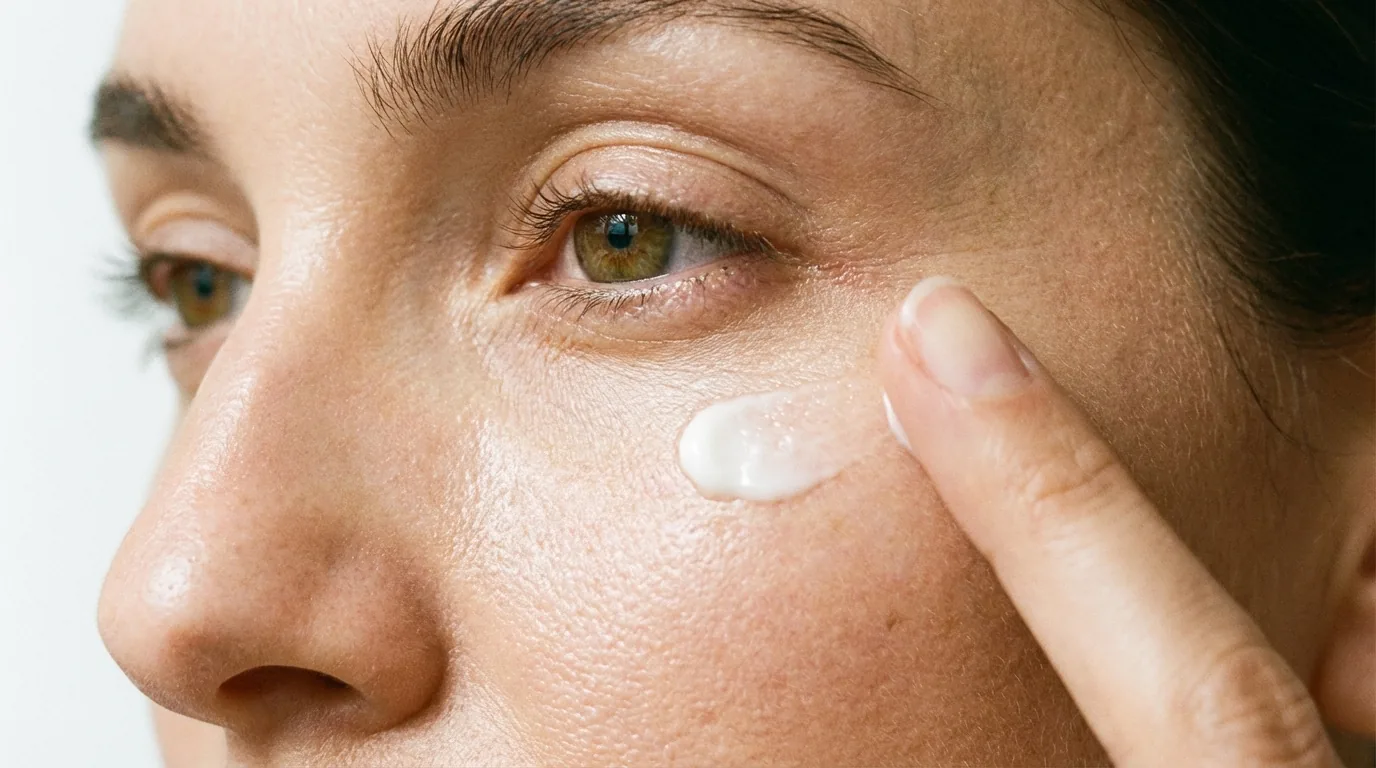
Key Takeaways
- •The periorbital area has anatomically different skin that may benefit from tailored formulations.
- •Many eye creams are simply repackaged facial moisturizers at higher price points.
- •Key ingredients to look for: retinol, caffeine, peptides, vitamin C, and vitamin K.
- •Eye creams cannot replace professional treatments for deep wrinkles or dark circles.
- •For mild concerns, your regular moisturizer may be sufficient for the eye area.
- •Application technique matters as much as the product itself.
What Makes Eye Skin Different
Before evaluating whether eye creams work, it's important to understand why the eye area warrants special attention. The periorbital skin is structurally distinct from the rest of the face in several meaningful ways. It's approximately 0.5mm thick — roughly one-third to one-quarter the thickness of skin on the rest of the face. This extreme thinness makes it more susceptible to dehydration, visible blood vessels, and the formation of fine lines.
The eye area contains fewer sebaceous glands than any other facial region, producing significantly less natural oil. This reduced oil production means the periorbital skin is inherently drier, more prone to moisture loss, and more reactive to environmental stressors. The lack of natural lipid protection also means this area is more susceptible to transepidermal water loss (TEWL) — the passive evaporation of moisture through the skin surface.
The constant movement of the orbicularis oculi muscle — engaged in blinking (approximately 10,000-15,000 times daily), squinting, smiling, and other expressions — subjects the overlying skin to relentless mechanical stress. Combined with the area's reduced structural support, this repetitive movement is the primary driver of crow's feet and other periorbital wrinkles.
The skin here also sits directly over a complex network of blood vessels and lymphatic channels that contribute to dark circles and puffiness. The thinness of the skin means that these underlying structures are more visible than elsewhere on the face, and any congestion or fluid accumulation in the area creates noticeable changes in appearance.
The Case For Eye Creams
Legitimate eye creams are formulated with the periorbital area's unique anatomy in mind. Good formulations tend to be lighter in texture to avoid milia (tiny white cysts that form when heavy products are applied near the eyes), ophthalmologist-tested for safety near the delicate ocular surface, and free of fragrances and essential oils that might cause irritation or allergic reactions in this sensitive area.
Certain active ingredients are delivered at lower, eye-appropriate concentrations. Retinol in an eye cream might be at 0.1-0.25% compared to 0.5-1% in a facial serum — this reduced concentration accounts for the thinner skin's increased absorption and sensitivity. Similarly, vitamin C in eye formulations may use gentler derivatives (ascorbyl glucoside or magnesium ascorbyl phosphate) rather than pure L-ascorbic acid, which can sting periorbital skin.
Ingredients specifically beneficial for periorbital concerns include caffeine (which constricts blood vessels and reduces puffiness), vitamin K (which may help diminish the appearance of dark circles caused by visible blood vessels), and haloxyl (a combination of chrysin, palmitoyl oligopeptide, and palmitoyl tetrapeptide-7 that addresses multiple dark circle mechanisms).
The CeraVe Eye Repair Cream represents a no-nonsense approach: ceramides for barrier repair, hyaluronic acid for hydration, and niacinamide for brightening — all at appropriate concentrations for the eye area, with the brand's MVE delivery technology providing sustained release. For those willing to invest more, Kiehl's Creamy Eye Treatment with Avocado has maintained a devoted following for its rich, moisturizing formula that performs well for dehydration-related fine lines.
The Case Against Eye Creams
The most common criticism is that many eye creams are functionally identical to their brands' facial moisturizers — same key ingredients, same concentration, same formulation base — but packaged in smaller containers at higher per-ounce prices. Independent analyses have confirmed this for numerous products across multiple price points, from drugstore to prestige brands.
For basic hydration and barrier support — the most common needs of the periorbital area — your regular facial moisturizer applied gently around the eyes is often sufficient. If your moisturizer contains ceramides, hyaluronic acid, and niacinamide, you're providing the eye area with the same fundamental ingredients that most eye creams deliver.
Marketing claims for eye creams frequently overstate what topical products can achieve for concerns like deep dark circles (which are often structural or genetic), deep-set wrinkles (which require professional treatment), and significant puffiness (which is often caused by fluid retention, allergies, or fat pad herniation that topical products cannot address).
The eye cream market is estimated at over $2 billion globally, driven largely by consumer anxiety about eye area aging and marketing that exploits this concern. While there are genuinely well-formulated eye products that serve a purpose, the category as a whole includes many products that offer no meaningful advantage over using your regular moisturizer around the eyes.
When an Eye Cream Is Worth It
An eye cream is most justified when your facial products are too strong for the eye area. If you use a high-concentration retinol (0.5%+), a potent AHA, or a vitamin C serum with pure L-ascorbic acid, these formulations may cause significant irritation around the eyes. A separate, gentler eye product allows you to treat the periorbital area with lower concentrations of the same actives.
If you have specific periorbital concerns — puffiness, dark circles, fine lines — that differ from your overall facial concerns, a targeted eye product with appropriate ingredients makes sense. A depuffing eye cream with caffeine, for instance, addresses a concern that your standard facial moisturizer likely doesn't.
For those with particularly sensitive periorbital skin prone to milia, contact dermatitis, or allergic reactions, a specifically tested, minimally formulated eye product reduces the risk of adverse reactions. Some facial products contain ingredients (certain silicones, heavy waxes, essential oils) that perform well on facial skin but cause problems around the delicate eye area.
If your facial moisturizer is very rich or occlusive (containing heavy butters, petrolatum, or thick balm textures), it may cause milia or puffiness when applied around the eyes. In this case, a lighter eye cream provides appropriate moisture without overwhelming the periorbital area.
Application Technique
How you apply product around the eyes matters significantly. Always use your ring finger — it naturally applies the least pressure. Dab rather than rub, working from the inner to outer corner along the orbital bone. Never apply product directly to the eyelid or too close to the lash line — product will migrate naturally into these areas via body heat and movement.
Apply to the entire orbital area — from the brow bone to the top of the cheekbone and from the inner corner to the temple. Most people under-apply, targeting only the immediate under-eye area while neglecting the outer corners (crow's feet zone) and the brow bone area where lines also develop.
Timing matters: apply eye products before heavier facial moisturizers and sunscreens. The lighter texture of most eye formulations is designed to penetrate first, and layering heavier products over them prevents interference with absorption. In the morning, always follow with SPF applied carefully around the eye area.
Consistency trumps product choice. Applying any appropriate moisturizing product consistently around the eyes — morning and evening, every day — produces better results than sporadic use of even the most expensive eye cream. The periorbital area's constant exposure to dehydration and environmental stress means it benefits enormously from reliable, daily hydration.
References
- Dréno B, et al. "The periorbital area: anatomy and aging." Journal of the European Academy of Dermatology and Venereology. 2017;31(S5):3-7.
- Ahmadraji F, Shatalebi MA. "Evaluation of the clinical efficacy and safety of an eye counter pad containing caffeine and vitamin K." Advanced Biomedical Research. 2015;4:11.
- Reszko AE, et al. "Anatomy, histology, and pathogenesis of the cosmetic concerns of the periorbital area." Clinics in Dermatology. 2014;32(6):761-767.
Related Articles
Crow's Feet: What Works and What Doesn't
January 20, 2025

The Real Difference Between Fine Lines and Deep Wrinkles
February 17, 2025

How Retinol Actually Works (And Why Most People Use It Wrong)
January 15, 2020

Under-Eye Circles: Which Ones Can Actually Be Treated
September 25, 2023