
Key Takeaways
- •Microneedling creates controlled micro-injuries that trigger the skin's wound healing cascade.
- •Professional microneedling uses needle depths of 1.0-2.5mm; at-home devices use 0.25-0.5mm.
- •3-6 professional sessions spaced 4-6 weeks apart are typical for acne scar improvement.
- •At-home dermarollers enhance product absorption but don't produce collagen remodeling.
- •Combining microneedling with PRP or growth factors may enhance results but evidence is still evolving.
- •Avoid microneedling if you have active acne, infections, or are on isotretinoin.
The Science of Controlled Injury
Microneedling, also known as collagen induction therapy or percutaneous collagen induction (PCI), works by creating thousands of tiny, controlled puncture wounds in the skin using fine needles. These micro-injuries trigger the skin's natural wound healing cascade, which proceeds through three overlapping phases: inflammation, proliferation, and remodeling.
During the inflammatory phase (days 1-5), platelets release growth factors including platelet-derived growth factor (PDGF), transforming growth factor beta (TGF-β), and fibroblast growth factor (FGF). These signaling molecules recruit fibroblasts and other repair cells to the treatment area. During proliferation (days 5-14), new blood vessels form and fibroblasts begin producing collagen III and other extracellular matrix components.
The remodeling phase extends from weeks 3 to 12 or longer, during which collagen III is gradually replaced by stronger collagen I and the new tissue matures. This is why the full results of microneedling become apparent months after the procedure rather than immediately. The entire process depends on the wound being deep enough to trigger a meaningful healing response but shallow enough to avoid scarring.
Professional vs. At-Home Devices
The distinction between professional and at-home microneedling is not just a matter of convenience — it's a fundamental difference in mechanism and outcomes. Professional devices (pen-type motorized devices like Dermapen or SkinPen) use needle depths of 1.0mm to 2.5mm, which is sufficient to reach the dermis and trigger genuine collagen remodeling.
At-home dermarollers typically feature needles of 0.25mm to 0.5mm — too short to reach the dermis in most areas of the face. These devices can create temporary channels in the stratum corneum that enhance the absorption of topical products, and they may stimulate very mild epidermal turnover. However, they do not produce the collagen remodeling that professional-depth needling achieves.
There's a reason professional microneedling requires numbing cream and produces visible redness and pinpoint bleeding while at-home rolling does not. The effective depth threshold for collagen induction is approximately 1.0mm, and anything less than that is cosmetic enhancement rather than collagen therapy. Both have value, but they should not be confused as equivalent treatments.

What Microneedling Can Treat
Acne scarring is the indication with the strongest evidence base for microneedling. A systematic review by Iriarte et al. (2017) found that microneedling produced clinically significant improvement in atrophic acne scars across multiple studies, with the best results for rolling scars and moderate results for boxcar scars. Ice pick scars, which are narrow and deep, respond less well and may require combination approaches.
Fine lines and skin laxity also respond to microneedling, though the improvements are more subtle than those achieved with ablative laser resurfacing. The advantage of microneedling over lasers is its safety profile across all skin types — unlike ablative lasers, microneedling carries minimal risk of post-inflammatory hyperpigmentation in darker skin tones because it doesn't generate thermal damage.
Stretch marks, surgical scars, and enlarged pores are additional indications where microneedling has shown benefit. A study by Aust et al. (2008) demonstrated significant improvement in skin roughness, wrinkle scores, and skin tautness following a series of microneedling treatments, with results maintained at the 12-month follow-up.
The Treatment Experience
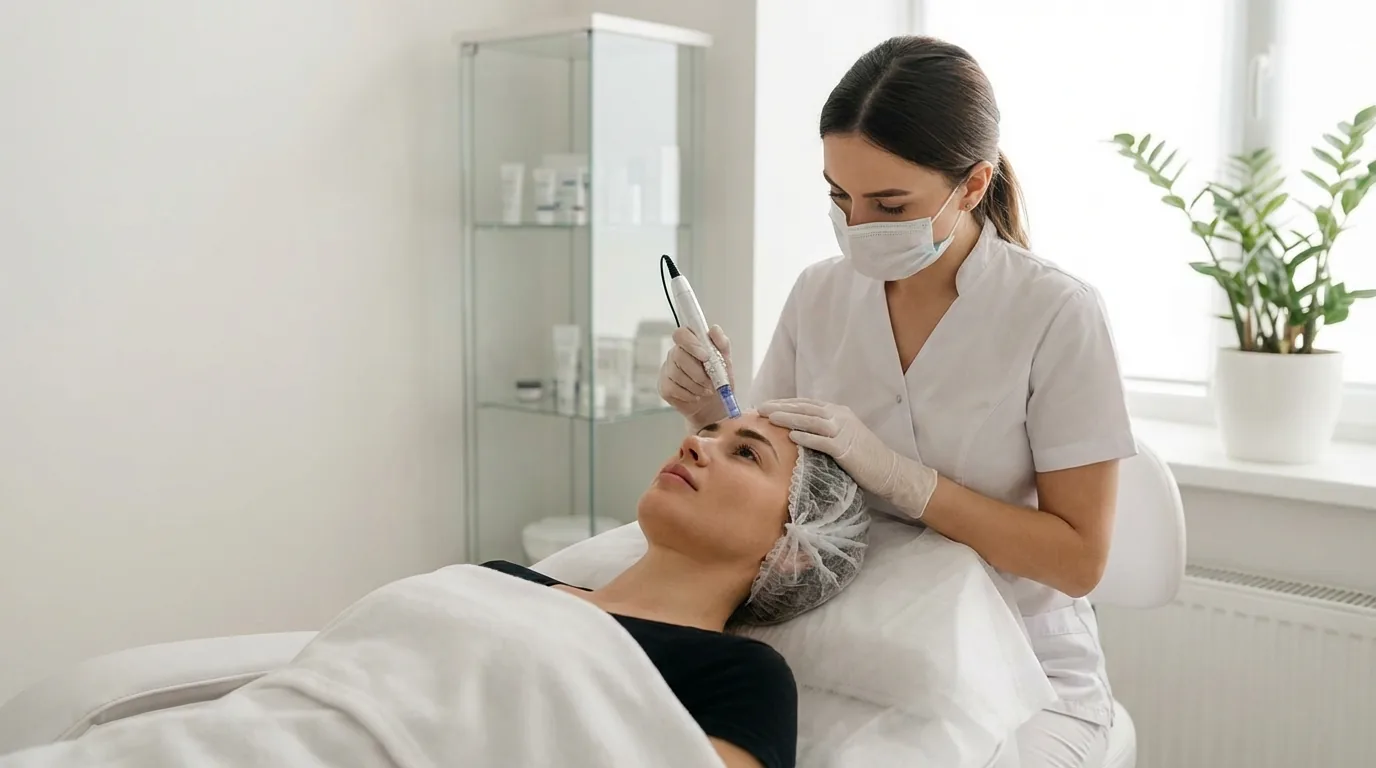
A professional microneedling session begins with thorough cleansing and the application of topical numbing cream (typically a lidocaine-based compound), which is left on for 30-45 minutes. The treatment itself takes 15-30 minutes depending on the area being treated. The practitioner moves the device systematically across the skin in multiple passes, adjusting needle depth based on the treatment area.
During the procedure, you can expect to feel pressure and vibration, with some areas being more sensitive than others — the forehead, upper lip, and jawline tend to be the most uncomfortable. The device creates tiny channels in the skin, producing pinpoint bleeding that indicates adequate treatment depth. This sounds alarming but is a normal and expected part of the process.
Immediately after treatment, the skin will appear significantly red, similar to a moderate sunburn. Some swelling is normal, particularly around the eyes and cheeks. Most practitioners apply a soothing serum or mask after the procedure. You should plan for 2-3 days of visible redness and avoid makeup, active ingredients, and direct sun exposure during this initial healing period.

Recovery and Aftercare
Days 1-2 post-treatment will be the most visibly impacted. The skin will be red, potentially swollen, and may feel tight and dry. Gentle cleansing with a fragrance-free micellar water or gentle cleanser is recommended. Apply a simple, occlusive moisturizer (nothing with active ingredients) and avoid touching the face unnecessarily.
By days 3-5, the redness typically fades to a mild pink, and some people experience mild flaking or peeling as the micro-channels heal. You can usually return to a normal skincare routine by day 5, though retinoids and chemical exfoliants should be avoided for at least one week. Sunscreen is absolutely non-negotiable — the newly formed skin is highly photosensitive.
Full healing occurs over 4-6 weeks, during which the collagen remodeling process is actively ongoing. Most treatment protocols call for 3-6 sessions spaced 4-6 weeks apart, with results building cumulatively over the course of the treatment series. Final results are typically assessed 3 months after the last session.
Red light therapy is increasingly used alongside microneedling in clinical settings to support healing and enhance collagen stimulation results. Learn more at our light therapy resource.
Microneedling with PRP and Other Adjuncts
Platelet-rich plasma (PRP), often marketed as the 'vampire facial,' involves drawing the patient's blood, centrifuging it to concentrate the platelets, and applying the PRP to the skin during or immediately after microneedling. The theory is that the concentrated growth factors in PRP will enhance the collagen remodeling response triggered by the needling.
The evidence for PRP-enhanced microneedling is encouraging but not definitive. Some studies show improved outcomes for acne scarring and rejuvenation compared to microneedling alone, while others show no significant difference. A meta-analysis by Defined et al. (2020) concluded that the combination appears to produce superior results for acne scars, but acknowledged that study quality was generally low.
Other adjuncts being studied include hyaluronic acid, growth factor serums, and exosomes applied during the microneedling procedure. The open channels created by the needles allow enhanced penetration of these topicals, potentially amplifying their effects. However, this also means that anything applied to freshly needled skin will penetrate more deeply than usual — which is why only sterile, medical-grade products should be used immediately post-treatment.
Who Should Avoid Microneedling
Microneedling is contraindicated in several situations. Active acne breakouts should not be needled — the needles can spread bacteria and worsen inflammation. Wait until active lesions have resolved before scheduling a treatment. Similarly, any active skin infection (bacterial, viral, or fungal) is an absolute contraindication.
Patients currently taking isotretinoin (Accutane) or who have taken it within the past six months should not undergo microneedling. Isotretinoin impairs the wound healing response and increases the risk of scarring. History of keloid scarring is a relative contraindication — while microneedling doesn't typically trigger keloid formation, the risk should be discussed with your dermatologist.
Blood clotting disorders, chronic skin conditions in the treatment area (active eczema, psoriasis, rosacea), and pregnancy are additional contraindications. Always disclose your complete medical history to your practitioner before treatment.
References
- Iriarte C, et al. "Review of applications of microneedling in dermatology." Clinical, Cosmetic and Investigational Dermatology. 2017;10:289-298.
- Aust MC, et al. "Percutaneous collagen induction therapy: an alternative treatment for scars, wrinkles, and skin laxity." Plastic and Reconstructive Surgery. 2008;121(4):1421-1429.
- Defined SR, et al. "Microneedling with PRP vs microneedling alone for acne scars: a meta-analysis." Journal of Cosmetic Dermatology. 2020;19(6):1340-1347.


