
Key Takeaways
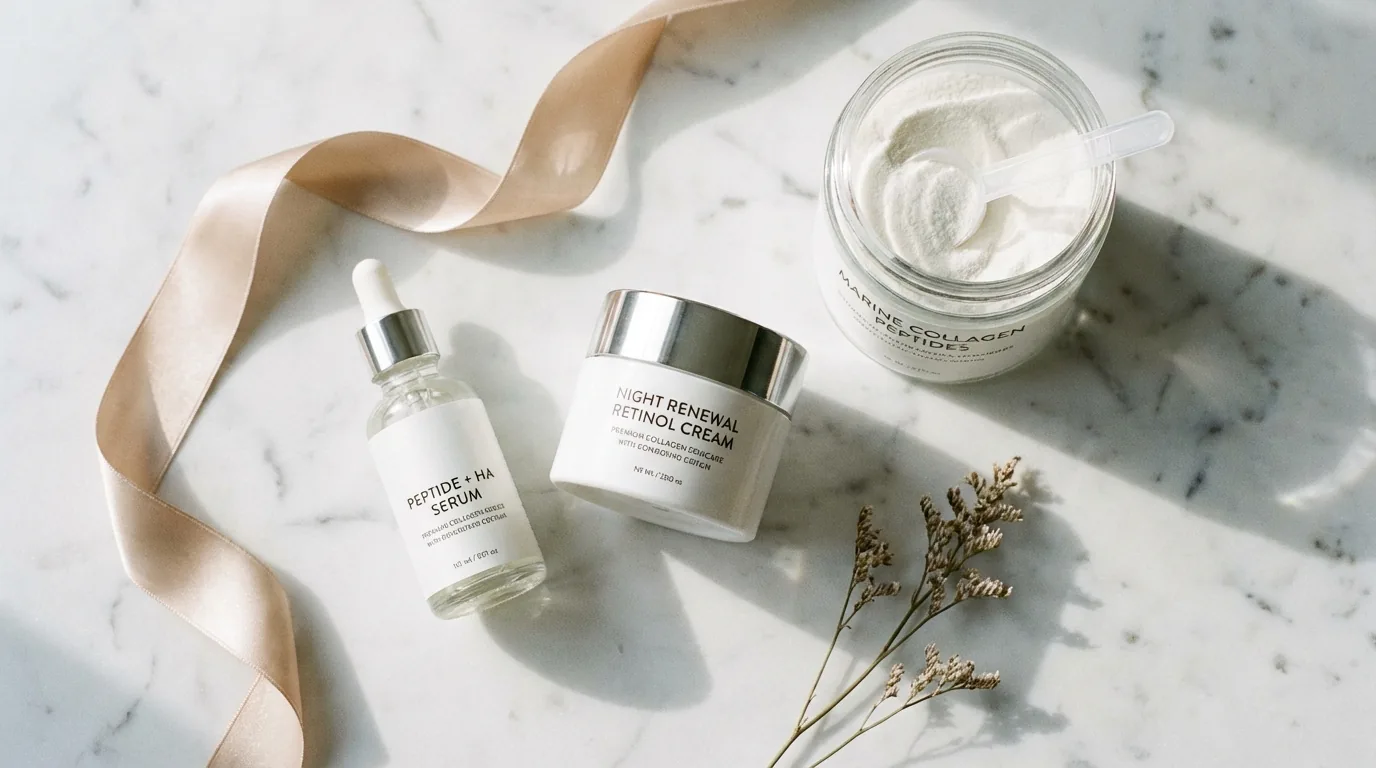
- •Topical collagen cannot penetrate the skin — it works only as a surface moisturizer.
- •Oral collagen supplements show modest but consistent benefits in clinical trials.
- •Retinoids are the most proven topical for stimulating dermal collagen production.
- •LED light therapy has genuine clinical backing for at-home collagen stimulation.
- •At-home microneedling at shallow depths provides mild collagen stimulation.
- •Peptides like matrixyl signal fibroblasts to increase collagen output.
The Collagen Treatment Landscape
The global collagen market is projected to exceed $20 billion by 2027, driven by consumer demand for anti-aging solutions and an explosion of products claiming to 'boost collagen.' Collagen-labeled products now span categories from topical serums and masks to oral supplements, injection treatments, and electronic devices — each with vastly different mechanisms and evidence bases. Navigating this landscape requires understanding what each approach can realistically achieve.
The fundamental challenge is that collagen molecules are too large to penetrate intact skin. Topical products labeled 'collagen cream' or 'collagen serum' that contain whole or minimally processed collagen proteins cannot reach the dermis where collagen resides. These products function as moisturizers — the collagen sits on the surface, forms a hydrating film, and may temporarily plump the appearance of fine lines, but it does not contribute to dermal collagen content.
Effective collagen treatments work through indirect mechanisms: they either provide the raw materials for collagen synthesis, signal fibroblasts to increase production, or create controlled injury that triggers the wound healing response. Understanding these mechanisms is essential for evaluating whether a product's claims are scientifically plausible.
It's also important to set realistic expectations. No at-home treatment can replicate the collagen-building capacity of professional procedures like ablative laser resurfacing or deep microneedling. However, several at-home approaches have genuine clinical evidence supporting meaningful — if more modest — improvements in dermal collagen density and skin quality.
Oral Collagen Supplements
Oral collagen supplements — typically hydrolyzed collagen peptides derived from bovine, marine, or porcine sources — have attracted significant clinical research in recent years. A 2019 systematic review in the Journal of Drugs in Dermatology analyzed 11 randomized controlled trials and concluded that collagen supplementation improved skin hydration, elasticity, and wrinkle depth compared to placebo across the majority of studies.
The proposed mechanism involves the absorption of collagen peptides from the gut into the bloodstream, where they reach the dermis and act as signaling molecules that stimulate fibroblast activity. Specific dipeptides — prolylhydroxyproline and hydroxyprolylglycine — have been identified as the bioactive compounds that may trigger fibroblast proliferation and collagen synthesis.
Vital Proteins Collagen Peptides is one of the most widely available and well-reviewed collagen supplements, providing hydrolyzed collagen peptides in a format that dissolves easily in hot or cold beverages. While no collagen supplement will produce dramatic visible results, consistent daily intake of 5-10 grams has shown statistically significant improvements in skin parameters across multiple clinical trials.
Limitations are important to acknowledge. The improvements seen in clinical trials, while statistically significant, are modest. Most studies run for 8-12 weeks and show improvements of 10-20% in parameters like hydration and elasticity — meaningful, but not transformative. Collagen supplements should be viewed as a supportive adjunct to topical treatments and sun protection, not a standalone anti-aging solution.
Topical Collagen-Boosting Ingredients
Retinoids remain the most effective topical agents for stimulating dermal collagen production. Their mechanism is well-established: retinoic acid binds to nuclear receptors on fibroblasts, directly upregulating collagen gene expression. This is not a surface-level effect — retinoids produce measurable increases in dermal collagen density visible on histological examination.
Vitamin C (L-ascorbic acid) at 10-20% concentration is the second most well-supported topical for collagen stimulation. Vitamin C serves as an essential cofactor for prolyl hydroxylase and lysyl hydroxylase — the enzymes that stabilize collagen's triple helix structure. Without adequate vitamin C, collagen molecules are structurally unstable and quickly degrade. Topical vitamin C simultaneously protects existing collagen from UV-induced free radical damage.
Peptides like Matrixyl (palmitoyl pentapeptide-4) and copper peptides (GHK-Cu) stimulate collagen production through signaling pathways. The Ordinary Buffet Multi-Technology Peptide Serum combines multiple peptide technologies — including matrixyl 3000 and matrixyl synthe'6 — with amino acids and hyaluronic acid to support collagen synthesis through multiple mechanisms simultaneously.
Growth factors derived from human fibroblast cultures or plant stem cells are marketed as collagen-boosting agents in numerous premium skincare products. While the concept is biologically plausible, the clinical evidence for topical growth factors in collagen stimulation is inconsistent and less robust than the evidence for retinoids, vitamin C, or peptides.
Device-Based At-Home Treatments
LED light therapy — particularly red and near-infrared wavelengths — is consistently one of the top recommendations from dermatologists for at-home collagen support. The research behind it is more robust than most topical collagen treatments. Red light at 630-660nm wavelengths stimulates mitochondrial cytochrome c oxidase, increasing ATP production and cellular energy that powers fibroblast activity and collagen synthesis.
Clinical trials of LED light therapy have shown improvements in skin roughness, fine wrinkle depth, and collagen density after 12-30 sessions. A 2014 study published in Photomedicine and Laser Surgery found that subjects treated with red and near-infrared light showed significantly increased intradermal collagen density compared to controls, with improvements visible clinically and confirmed through ultrasound measurements.
At-home microneedling (dermarolling) at shallow depths (0.25-0.5mm) provides mild collagen stimulation through controlled micro-injury. While professional microneedling at depths of 1.5-2.5mm produces more significant collagen remodeling, at-home devices at appropriate shallow depths can stimulate the wound healing response and enhance the penetration and efficacy of topical collagen-boosting actives applied immediately after treatment.
Microcurrent devices (NuFace, ZIIP) are marketed for facial toning and collagen stimulation. The evidence base is more limited than for LED or microneedling, though some small studies have shown improvements in facial contour and skin texture. The effects are primarily related to muscle stimulation rather than direct collagen induction, and the improvements tend to be temporary without consistent ongoing use.
What Doesn't Work
Topical collagen products — creams, serums, and masks containing collagen as an ingredient — do not increase dermal collagen. Collagen molecules are far too large (300,000+ daltons) to penetrate the epidermal barrier. Even 'hydrolyzed' collagen in topical products rarely reaches the dermis in meaningful amounts. These products work as hydrating moisturizers, which has legitimate value, but the collagen-building claims are unfounded.
Collagen-infused sheet masks, collagen mists, and similar products provide temporary hydration that can plump the skin and reduce the appearance of fine lines for a few hours. This is a surface effect — not collagen building — and should be understood as such. These products are fine for pre-event preparation but are not anti-aging treatments.
Bone broth, while nutritious, has not been clinically demonstrated to increase skin collagen when consumed as part of a normal diet. While it provides amino acids (glycine, proline) used in collagen synthesis, these amino acids are also abundant in many other protein sources and are not preferentially directed to skin collagen production.
Collagen 'banking' — the idea that aggressive collagen-stimulating treatments in your 20s will create a collagen reserve that prevents future aging — is an oversimplification. While early sun protection and retinoid use do preserve collagen, you cannot 'stockpile' excess collagen that prevents future decline. Collagen maintenance requires ongoing effort, not front-loaded intervention.
References
- Choi FD, et al. "Oral collagen supplementation: a systematic review of dermatological applications." Journal of Drugs in Dermatology. 2019;18(1):9-16.
- Wunsch A, Matuschka K. "A controlled trial to determine the efficacy of red and near-infrared light treatment in patient satisfaction, reduction of fine lines, wrinkles, skin roughness, and intradermal collagen density increase." Photomedicine and Laser Surgery. 2014;32(2):93-100.
- Mukherjee S, et al. "Retinoids in the treatment of skin aging." Clinical Interventions in Aging. 2006;1(4):327-348.
Related Articles

How Collagen Loss Actually Works and How to Slow It Down
March 17, 2025

Why Your Skin Loses Firmness After 30 and What Actually Helps
January 6, 2025

Red Light Therapy for Anti-Aging: What Dermatologists Actually Think
June 9, 2025

Peptides 101: Do They Actually Do Anything
November 28, 2022