

Key Takeaways
- •Collagen makes up 75-80% of the dry weight of the dermis.
- •Production declines ~1% per year after age 25, accelerating after menopause.
- •UV exposure is the biggest modifiable accelerator of collagen destruction.
- •Retinoids, vitamin C, and peptides can stimulate collagen production topically.
- •Red light therapy has clinical evidence for non-invasive collagen stimulation.
- •Collagen supplements show modest benefits for skin hydration and elasticity.
The Structure and Role of Collagen in Skin
Collagen is the most abundant protein in the human body and the primary structural component of the dermis. It constitutes approximately 75-80% of the dry weight of skin and provides the tensile strength and structural framework that gives skin its firm, resilient quality. There are at least 28 identified types of collagen, but types I and III predominate in skin, with type I accounting for approximately 80% and type III for approximately 15% of dermal collagen.
Collagen molecules are organized into a hierarchical structure: individual collagen chains wind into triple helices, which assemble into fibrils, which bundle into fibers. This rope-like architecture gives collagen extraordinary tensile strength — gram for gram, type I collagen is stronger than steel. The cross-links between collagen molecules provide additional structural integrity and give healthy skin its characteristic firmness and bounce.
Fibroblasts — specialized cells in the dermis — are responsible for collagen synthesis. The process begins with procollagen production inside the cell, which is then secreted into the extracellular space and assembled into mature collagen fibers. This synthesis requires several cofactors, most notably vitamin C, which is essential for the hydroxylation of proline and lysine residues that stabilize the triple helix structure. Without adequate vitamin C, collagen molecules are unstable and quickly degrade.
The extracellular matrix (ECM) provides the environment in which collagen fibers are organized and maintained. Glycosaminoglycans (GAGs) like hyaluronic acid fill the spaces between collagen fibers, retaining water and creating the gel-like medium that keeps collagen hydrated, flexible, and functional. The health of the ECM directly impacts collagen quality and longevity.
Why Collagen Declines with Age
Collagen decline results from two simultaneous processes: reduced production and increased degradation. After approximately age 25, fibroblast activity gradually decreases, producing less procollagen and generating new collagen at a progressively slower rate. The fibroblasts themselves become less numerous and less responsive to growth factors that stimulate collagen synthesis.
Simultaneously, the activity of matrix metalloproteinases (MMPs) — enzymes that break down collagen and other ECM components — increases with age. In young skin, the balance between collagen synthesis and MMP-mediated degradation favors net collagen accumulation. As this balance shifts toward net degradation, the total collagen content of the dermis decreases year over year.
The remaining collagen also deteriorates in quality. Cross-linking between collagen fibers increases with age, making the collagen network more rigid and less elastic. Advanced glycation end-products (AGEs) — formed when sugars react with collagen proteins — further stiffen and discolor collagen fibers. The combination of fewer, stiffer, more fragmented collagen fibers produces the thin, less resilient skin characteristic of aging.
Hormonal changes accelerate collagen loss at specific life stages. For women, the decline in estrogen during perimenopause and menopause triggers a dramatic acceleration in collagen loss — studies indicate a 30% decline in dermal collagen in the first five postmenopausal years. Estrogen directly stimulates fibroblast activity and collagen synthesis, and its decline removes a major driver of collagen production.
External Factors That Accelerate Collagen Loss
Ultraviolet radiation is the most potent external destroyer of collagen. UV exposure activates MMPs in the dermis, dramatically increasing collagen degradation. A single episode of UV exposure can elevate MMP levels for up to 48 hours, during which collagen destruction proceeds at an accelerated rate. Chronic UV exposure creates a sustained state of elevated MMP activity that relentlessly degrades dermal collagen.
Pollution and environmental toxins contribute through oxidative stress. Particulate matter, ozone, and other airborne pollutants generate free radicals that damage collagen directly and activate inflammatory pathways that stimulate MMP production. Urban dwellers consistently show more advanced signs of collagen loss compared to rural populations of the same age, controlling for other factors.
Smoking is devastating for collagen. Tobacco smoke contains thousands of chemicals that constrict dermal blood vessels, reduce oxygen delivery, generate massive free radical loads, and activate MMPs. Smokers consistently show 40% less dermal collagen than non-smokers of the same age, and the characteristic deep wrinkles of long-term smokers reflect this accelerated collagen destruction.
High-sugar diets promote glycation — the chemical reaction between glucose and collagen proteins that produces AGEs. Glycated collagen is stiffer, more brittle, and resistant to normal enzymatic turnover, meaning it persists in a damaged, non-functional state rather than being replaced by fresh collagen. Reducing refined sugar intake is one of the most impactful dietary changes for preserving collagen quality.
Evidence-Based Strategies to Stimulate Collagen
Retinoids (tretinoin, adapalene, retinol) are the most well-studied topical agents for collagen stimulation. They work by binding to retinoic acid receptors on fibroblasts, directly upregulating collagen gene expression. Tretinoin has been shown to increase procollagen I production by 80% after 12 months of use in photoaged skin. Over-the-counter retinol is converted to retinoic acid in the skin, producing similar but more gradual effects.
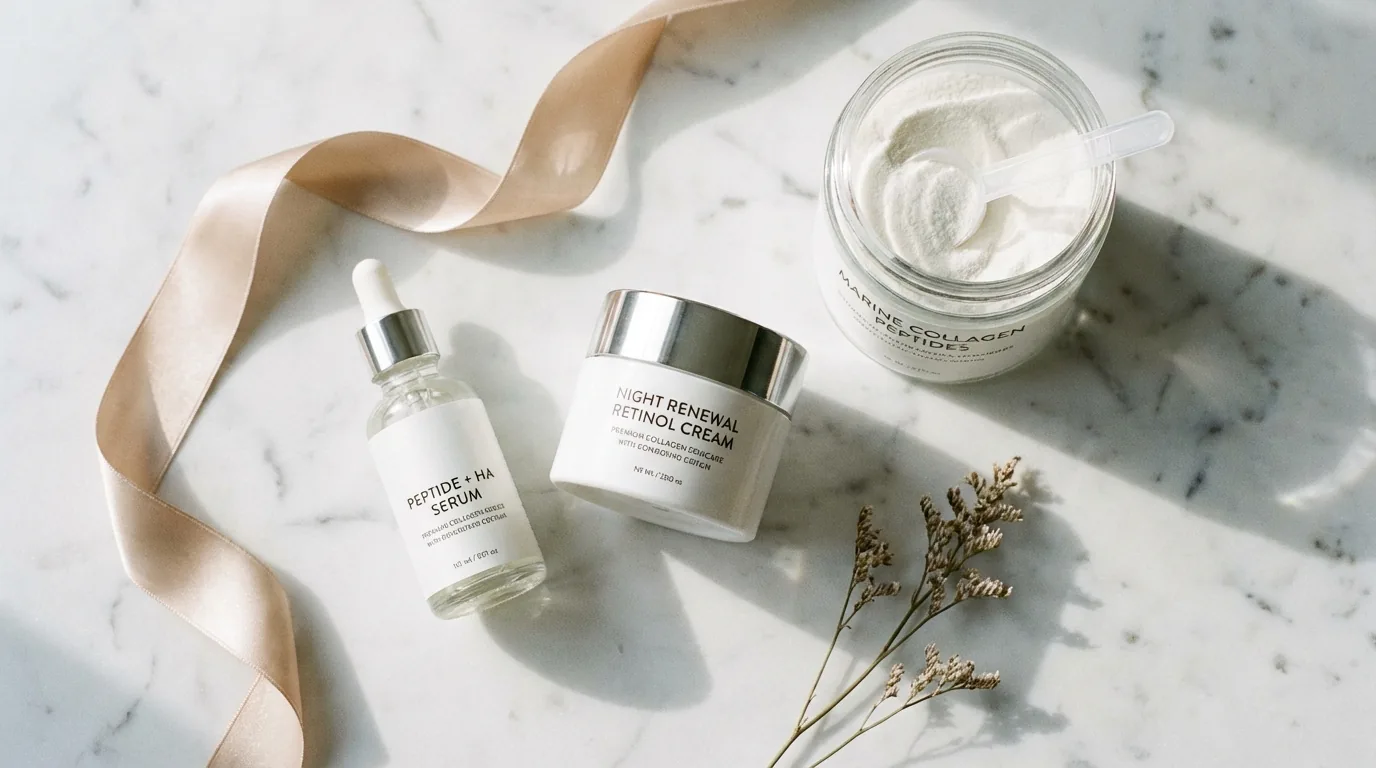
Vitamin C is essential for collagen synthesis as a cofactor for the enzymes that stabilize collagen's triple helix structure. Topical vitamin C at 10-20% concentration has been shown to stimulate collagen production independently of its antioxidant effects. The The Ordinary Buffet Multi-Technology Peptide Serum combines multiple peptide technologies including matrixyl and copper peptides that signal fibroblasts to increase collagen production.
Device-based treatments like red light therapy work by stimulating mitochondrial activity in skin cells, which in turn supports collagen synthesis. It is one of the few at-home treatments with genuine clinical research behind it for collagen stimulation. Red light at 630-660nm wavelengths has been shown to increase fibroblast proliferation and procollagen synthesis in both in vitro and clinical studies.
Collagen supplements — typically hydrolyzed collagen peptides taken orally — have shown modest but consistent benefits in recent clinical trials. A 2019 meta-analysis in the Journal of Drugs in Dermatology found that oral collagen supplementation improved skin hydration, elasticity, and wrinkle depth compared to placebo. Vital Proteins Collagen Peptides is one of the more widely available and well-reviewed options in this category.
Professional Collagen-Building Treatments
Microneedling creates thousands of controlled micro-punctures that trigger the wound healing cascade, resulting in new collagen and elastin deposition. Clinical studies show up to 400% increase in collagen I and III levels after a series of treatments. The depth of needling correlates with the degree of collagen stimulation — deeper treatments (1.5-2.5mm) produce more significant remodeling but require trained practitioners.
Fractional laser treatments stimulate collagen through photothermal injury — the controlled heating of dermal tissue activates the wound healing response and triggers robust neocollagenesis. Both ablative (CO2, erbium) and non-ablative (1540nm, 1550nm) fractional lasers have demonstrated significant increases in dermal collagen density in histological studies.
Radiofrequency (RF) treatments deliver thermal energy that causes immediate collagen fiber contraction and denaturation, followed by months of new collagen production as part of the healing response. Monopolar and bipolar RF devices have been used for skin tightening, and newer microneedle RF devices combine the benefits of microneedling with RF energy for enhanced collagen stimulation.
Injectable biostimulators (Sculptra, Radiesse) work differently from traditional fillers — rather than simply adding volume, they stimulate the body's own collagen production around the injected material. Poly-L-lactic acid (Sculptra) gradually stimulates neocollagenesis over several months, producing natural-looking volume restoration that can last 2-3 years.
Building a Collagen-Protective Lifestyle
Sun protection is the single most effective collagen-preservation strategy. Daily broad-spectrum SPF 30+ prevents the MMP activation and oxidative damage that accounts for the majority of preventable collagen destruction. This one habit has a larger impact on collagen preservation than any supplement, treatment, or product.
A diet rich in vitamin C, protein (providing proline, lysine, and glycine), and antioxidants supplies the raw materials for collagen synthesis and protects existing collagen from oxidative damage. Bone broth, citrus fruits, berries, leafy greens, and lean meats provide an excellent nutritional foundation for collagen support.
Adequate sleep is essential for collagen maintenance. Growth hormone, which peaks during deep sleep, stimulates fibroblast activity and collagen synthesis. Chronic sleep deprivation reduces growth hormone secretion and elevates cortisol, creating a hormonal environment that favors collagen breakdown.
Regular moderate exercise improves circulation, delivering nutrients and oxygen to fibroblasts while removing waste products. Exercise also reduces systemic inflammation and improves insulin sensitivity — both factors that support collagen quality and longevity. However, excessive high-intensity exercise without adequate recovery can elevate cortisol and potentially counteract some of these benefits.
References
- Varani J, et al. "Decreased collagen production in chronologically aged skin." American Journal of Pathology. 2006;168(6):1861-1868.
- Quan T, et al. "Matrix-degrading metalloproteinases in photoaging." Journal of Investigative Dermatology Symposium Proceedings. 2009;14(1):20-24.
- Choi FD, et al. "Oral collagen supplementation: a systematic review of dermatological applications." Journal of Drugs in Dermatology. 2019;18(1):9-16.
- Brincat M, et al. "A study of the decrease of skin collagen content, skin thickness, and bone mass in the postmenopausal woman." Obstetrics and Gynecology. 1987;70(6):840-845.
Related Articles

Why Your Skin Loses Firmness After 30 and What Actually Helps
January 6, 2025

Retinol for Anti-Aging: The Complete Guide to Getting Started
April 1, 2025
At-Home Collagen Treatments: What the Research Actually Says
May 26, 2025

Peptides 101: Do They Actually Do Anything
November 28, 2022