
Key Takeaways
- •Neck skin has fewer sebaceous glands and less subcutaneous fat than facial skin.
- •The décolletage receives chronic sun exposure that most people fail to protect against.
- •Extending your facial skincare routine to your neck and chest is the simplest preventive step.
- •Retinoids, vitamin C, and peptides are all effective for treating existing neck aging.
- •Professional treatments including laser and RF can address moderate to severe damage.
- •Sleeping position significantly impacts chest wrinkling patterns.
Why Neck and Chest Skin Is Different
The skin on your neck and décolletage is structurally distinct from facial skin in ways that make it inherently more vulnerable to aging. The epidermis and dermis are thinner, with fewer layers of cells providing less of a protective barrier. There are fewer melanocytes, meaning less natural UV protection. The dermis contains fewer fibroblasts producing less collagen and elastin, resulting in less structural support from the outset.
Sebaceous gland density drops significantly below the jawline. While the face — particularly the T-zone — produces abundant sebum that naturally moisturizes and protects the skin, the neck and chest are comparatively oil-poor. This means they're more prone to dehydration, barrier impairment, and the visible effects of environmental exposure. The reduced lipid content makes these areas more susceptible to transepidermal water loss (TEWL) and irritation from active ingredients.
The platysma muscle — a thin, broad muscle that extends from the chest across the neck to the jawline — creates unique dynamic wrinkling patterns. Unlike the thicker, more precisely controlled facial muscles, the platysma's broad contractions create horizontal necklace lines and contribute to the 'turkey neck' appearance associated with neck aging. These bands become more prominent as the muscle loses tone and the overlying skin loses elasticity.
The décolletage presents additional challenges. The chest area receives chronic low-grade sun exposure through V-neck clothing, often without sunscreen protection. Years of cumulative UV damage create the characteristic mottled pigmentation, crepey texture, and deep vertical wrinkles that many people develop in their 40s and 50s. The flat surface area and position of the chest make it particularly susceptible to sleep-related compression wrinkles.
Common Signs of Neck and Chest Aging
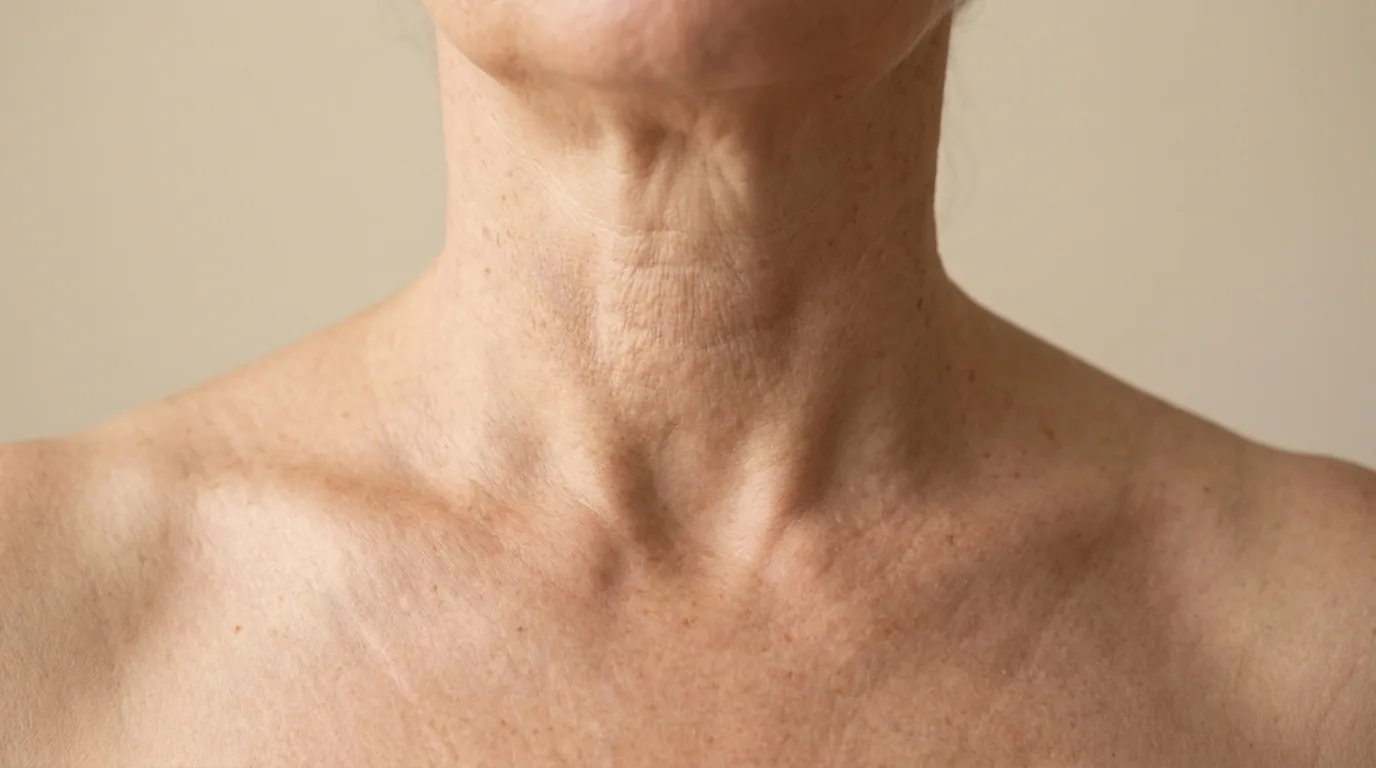
Horizontal necklace lines — the ring-like creases that encircle the neck — are among the earliest signs of neck aging and are partially influenced by genetics. While some people develop pronounced necklace lines in their 20s, they typically deepen significantly in the 30s and 40s as collagen loss accelerates and skin laxity increases.
Vertical platysmal bands — the rope-like structures that run from the chin to the clavicle — become more prominent with age as the platysma muscle separates along its midline and the overlying skin thins. These bands are a common complaint and are one of the primary indications for neck-specific treatments including Botox and surgical intervention.
The décolletage develops its own distinctive aging pattern: a combination of solar lentigines (sun spots), poikiloderma (a mottled mixture of redness, brown pigmentation, and skin thinning), and crepey texture characterized by extremely fine, crinkled lines visible across the entire chest surface. The vertical cleavage wrinkle that runs between the breasts is particularly common in side sleepers.
Loss of definition along the jawline and development of submental fullness (a double chin) represent the combined effects of skin laxity, fat redistribution, and gravitational pull. While partially influenced by weight fluctuations, these changes are primarily driven by structural aging of the skin and underlying tissues.
Topical Treatments for Neck and Chest
The most straightforward approach is extending your existing facial skincare routine below the jawline. Your retinoid, vitamin C serum, moisturizer, and sunscreen should all be applied to the neck and chest as a matter of course. However, there are important modifications to make: the neck and chest may be more sensitive to retinoids than your face, so start with a lower concentration or frequency and build tolerance gradually.
The StriVectin TL Advanced Tightening Neck Cream is specifically formulated for the thinner, more delicate skin of the neck area, combining peptides with gravitite-CF lifting complex to address visible laxity and horizontal lines. For a higher-end option, Revision Skincare Nectifirm is widely recommended by dermatologists and contains a blend of plant extracts and peptides clinically shown to improve neck firmness.
Vitamin C serums are particularly valuable for the décolletage because they address both UV-induced pigmentation and collagen loss. Look for stabilized L-ascorbic acid formulations at 10-15% concentration. The antioxidant protection is especially important for the chest area, which often receives incidental sun exposure throughout the day.
Alpha hydroxy acids (glycolic acid, lactic acid) at moderate concentrations (8-12%) can improve texture and reduce crepiness on the neck and chest. However, these areas are more prone to irritation than the face, so introduce acids slowly and always pair with adequate moisturization. Mandelic acid, being larger in molecular size, penetrates more slowly and may be better tolerated on sensitive neck skin.
Professional Treatment Options
Intense Pulsed Light (IPL) therapy is often the first-line professional treatment for décolletage aging, particularly when poikiloderma (mixed redness and pigmentation) is the primary concern. IPL effectively targets both melanin and hemoglobin, reducing brown spots and diffuse redness simultaneously. A series of 3-5 sessions typically produces significant improvement in overall chest tone and clarity.
Fractional laser resurfacing — both ablative (CO2, erbium) and non-ablative (Fraxel) — can address deeper textural damage and stimulate meaningful collagen remodeling in the neck and chest. Ablative treatments provide more dramatic results but carry higher risk of complications in these areas, including prolonged erythema and scarring. Non-ablative treatments offer a better safety profile for non-facial skin.
Radiofrequency (RF) treatments and microneedling are increasingly popular for neck tightening. RF microneedling devices combine the collagen-stimulating benefits of both modalities and have shown particular promise for neck laxity and décolletage crepiness. Results develop gradually over 3-6 months as new collagen matures.
Botox injections into the platysma muscle can soften prominent vertical bands and provide a subtle lifting effect (the 'Nefertiti lift'). This off-label use requires precise technique and typically uses 25-50 units distributed along the platysmal bands. Results last approximately 3-4 months.
Prevention and Daily Habits
Sun protection for the neck and chest is arguably more important than for the face, given these areas' reduced natural defenses and chronic exposure history. Apply broad-spectrum SPF 30+ to the entire neck, chest, and décolletage every morning, regardless of whether you plan to have these areas exposed. UV radiation penetrates light clothing, and incidental exposure through V-neck shirts accumulates significantly over decades.
Sleep position is a major modifiable risk factor for chest wrinkling. Side sleeping compresses the chest skin for 6-8 hours nightly, creating vertical and diagonal creases that become permanent over time. Sleeping on your back eliminates this compression entirely. For those who can't switch to back sleeping, specialized pillow designs and chest-specific silicone patches worn during sleep can minimize compression damage.
Moisturize the neck and chest liberally. These areas need more moisture than the face due to their lower sebaceous gland density. Look for body moisturizers containing ceramides, hyaluronic acid, and niacinamide — ingredients that support barrier function and attract moisture. Apply immediately after showering to lock in hydration.
Avoid harsh scrubs and rough physical exfoliation on the neck and chest. The thinner skin in these areas is more easily damaged by abrasive products, leading to micro-tears, inflammation, and accelerated aging. Chemical exfoliation with gentle AHAs is always preferred over physical scrubs for these delicate regions.
References
- Guinot C, et al. "Relative contribution of intrinsic vs extrinsic factors to skin aging as determined by a validated skin age score." Archives of Dermatology. 2002;138(11):1454-1460.
- Draelos ZD. "The ability of sunscreens to protect against ultraviolet-induced skin aging." Dermatologic Therapy. 2012;25(3):254-260.
- Sjerobabski-Masnec I, Situm M. "Skin aging." Acta Clinica Croatica. 2010;49(4):515-518.
Related Articles

Sun Damage: How to Fade It and Stop It Getting Worse
March 3, 2025

How Collagen Loss Actually Works and How to Slow It Down
March 17, 2025

Why Your Skin Loses Firmness After 30 and What Actually Helps
January 6, 2025

What Happens to Your Skin If You Never Wear Sunscreen
January 13, 2025