

Key Takeaways
- •Up to 80% of visible facial aging is attributed to UV exposure.
- •Sun damage manifests as pigmentation changes, textural irregularities, and collagen loss.
- •Vitamin C, retinoids, and niacinamide are the most effective topicals for fading sun damage.
- •SPF 30+ daily use is the single most important step in preventing further damage.
- •Professional treatments like IPL and chemical peels can accelerate sun damage reversal.
- •Even significant sun damage can be meaningfully improved with consistent treatment.
Understanding How Sun Damage Accumulates
Ultraviolet radiation causes skin damage through multiple mechanisms that operate simultaneously. UVB rays (280-315nm) primarily affect the epidermis, causing direct DNA damage through the formation of cyclobutane pyrimidine dimers. This DNA damage triggers the tanning response — melanin production is actually a damage control mechanism, not a sign of healthy sun exposure. UVA rays (315-400nm) penetrate deeper into the dermis, generating reactive oxygen species that damage collagen, elastin, and cellular DNA through oxidative stress.
What makes sun damage particularly insidious is its cumulative and delayed nature. The majority of UV damage occurs gradually over years and decades, with visible changes often appearing 10-20 years after the exposure that caused them. A single severe sunburn in your teens may not manifest as visible damage until your 30s or 40s. This delay between cause and effect is why sun protection needs to start early — by the time damage becomes visible, substantial structural changes have already occurred.
Photoaging — the term dermatologists use for UV-induced skin aging — is distinct from chronological aging in both its mechanisms and its clinical appearance. Chronologically aged skin becomes thin, dry, and develops fine wrinkles while maintaining a relatively uniform appearance. Photoaged skin, by contrast, develops coarse wrinkles, mottled pigmentation, telangiectasias (visible blood vessels), solar lentigines (sun spots), and a leathery texture with deep furrows. The two processes overlap and compound each other.
The concept of 'lifetime UV dose' is important for understanding individual risk. Those who grew up in sunny climates, spent extensive time outdoors without protection, or used tanning beds have accumulated larger doses and typically show more severe photoaging. However, even seemingly modest daily exposure — walking to the car, sitting near windows — contributes to cumulative damage over decades.
Types of Visible Sun Damage
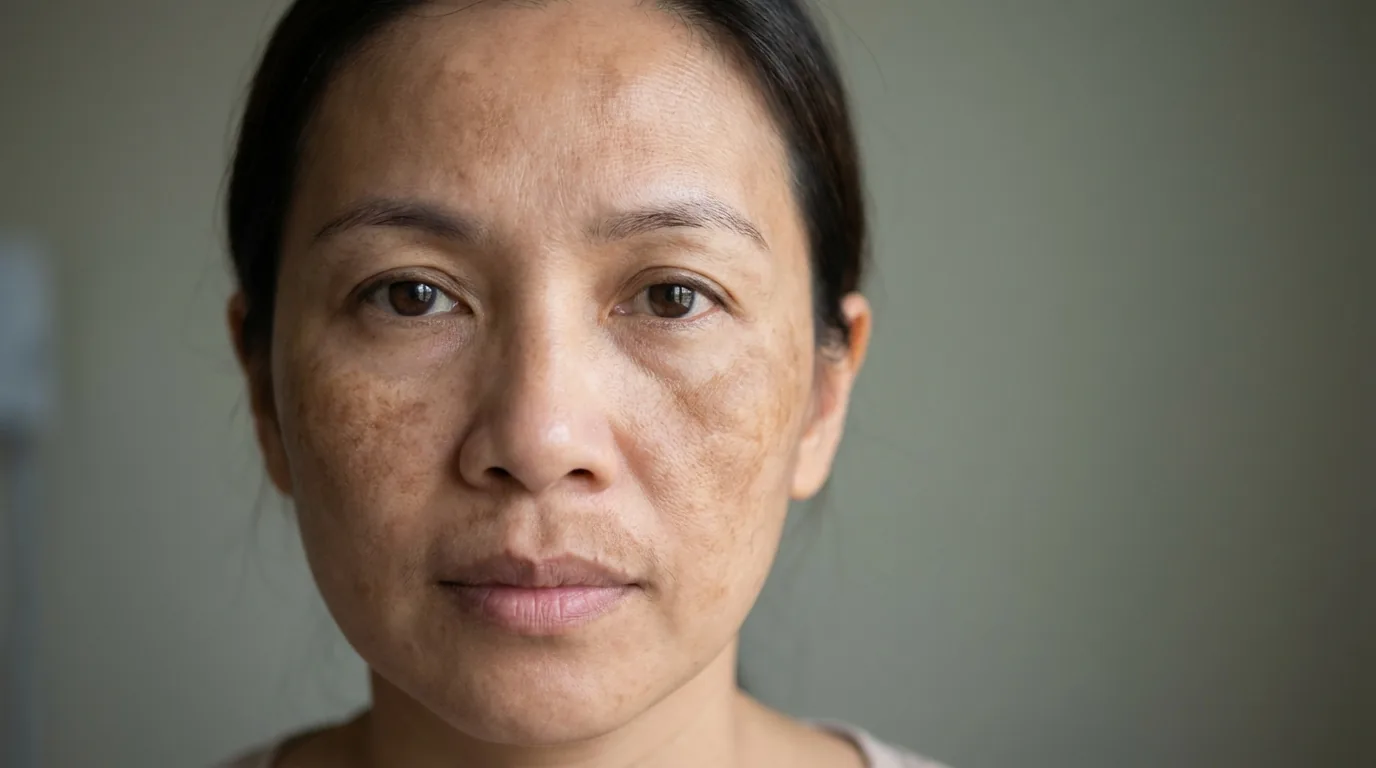
Solar lentigines (commonly called sun spots, age spots, or liver spots) are flat, well-defined brown patches caused by localized overproduction of melanin in response to cumulative UV exposure. They appear most commonly on chronically sun-exposed areas: the face, hands, chest, and forearms. Unlike freckles, which fade with reduced sun exposure, solar lentigines are permanent unless treated.
Melasma, while not exclusively caused by UV exposure, is dramatically worsened by it. This condition produces larger, less defined patches of hyperpigmentation — typically on the forehead, cheeks, upper lip, and nose — and has a strong hormonal component. UV exposure triggers melanocyte activation in melasma-prone skin, making sun protection absolutely critical for managing this condition.
Actinic keratoses are rough, scaly patches that represent pre-cancerous changes in sun-damaged skin. While beyond the scope of cosmetic treatment, their presence indicates significant cumulative UV damage and should prompt both medical evaluation and aggressive photoprotection going forward. They serve as a clinical marker of the level of UV damage the skin has sustained.
Textural changes — including roughness, sallowness, enlarged pores, and the crepey, leathery quality associated with heavily sun-damaged skin — result from UV-induced degradation of collagen and elastin in the dermis combined with epidermal thickening. Solar elastosis, the accumulation of abnormal elastin material in the dermis, gives severely photoaged skin its characteristic yellowish, thickened appearance.
Topical Treatments for Fading Sun Damage
Vitamin C (L-ascorbic acid) is the cornerstone of topical sun damage treatment. At concentrations of 10-20%, it inhibits tyrosinase (the enzyme that drives melanin production), provides potent antioxidant protection against ongoing UV damage, and stimulates collagen synthesis to improve texture. The Timeless Vitamin C Serum combines 20% L-ascorbic acid with vitamin E and ferulic acid — a combination shown by Duke University researchers to enhance vitamin C's photoprotective efficacy by 800%.
Retinoids (tretinoin, adapalene, retinol) accelerate cell turnover, which helps shed pigmented surface cells and brings fresher, less damaged cells to the surface. They also stimulate dermal collagen production, gradually improving the textural changes associated with photoaging. Tretinoin 0.025-0.05% has been shown in clinical trials to significantly improve mottled pigmentation, fine wrinkling, and roughness within 6-12 months.
Niacinamide (vitamin B3) at 4-5% concentration has been demonstrated to reduce the transfer of melanosomes from melanocytes to keratinocytes, effectively reducing the appearance of existing pigmentation. It also strengthens the skin barrier, reduces inflammation, and improves overall skin tone — making it an excellent adjunctive treatment for sun-damaged skin.
The EltaMD UV Clear SPF 46 is a dermatologist favorite that combines broad-spectrum protection with niacinamide, helping to both prevent further damage and treat existing pigmentation simultaneously. For targeted dark spot treatment, SkinCeuticals Discoloration Defense combines tranexamic acid, niacinamide, and HEPES in a formula clinically proven to reduce stubborn discoloration.
Professional Treatments
Intense Pulsed Light (IPL) therapy is often considered the gold standard professional treatment for diffuse sun damage. IPL devices emit broad-spectrum light that selectively targets melanin and hemoglobin, reducing both brown spots and redness in a single treatment. A typical course of 3-5 sessions, spaced 3-4 weeks apart, can dramatically improve the mottled, uneven appearance of sun-damaged skin.
Chemical peels at various depths address sun damage through controlled exfoliation and stimulation of skin renewal. Superficial peels (glycolic acid 30-70%) improve surface pigmentation and texture with minimal downtime. Medium-depth peels (TCA 15-35%) reach the papillary dermis and produce more significant improvement in deeper pigmentation and fine wrinkles. Deep peels (phenol-based) produce the most dramatic results but carry significant risks and extended recovery.
Fractional laser treatments — both ablative and non-ablative — create columns of controlled injury that stimulate collagen remodeling while leaving islands of healthy tissue for rapid healing. These treatments are particularly effective for the textural changes associated with photoaging, including roughness, enlarged pores, and fine wrinkles. Multiple sessions of non-ablative fractional laser can produce cumulative improvement comparable to a single ablative treatment with less downtime.
Cryotherapy is a targeted approach for individual solar lentigines. Liquid nitrogen applied briefly to isolated sun spots destroys the pigmented cells, causing them to crust and fall off within 1-2 weeks. While effective for spot treatment, it carries a risk of leaving behind light or dark marks, particularly on darker skin tones.
Prevention: Stopping Further Damage
Daily broad-spectrum SPF 30+ is non-negotiable — and yes, you need sunscreen even on cloudy days. This single habit prevents more future sun damage than any treatment can reverse. Apply at least 1/4 teaspoon to the face, and reapply every 2 hours during sun exposure. Many people significantly under-apply sunscreen, reducing the actual protection to a fraction of the labeled SPF.
Protective clothing, wide-brimmed hats, and UV-blocking sunglasses provide physical barriers that complement sunscreen application. UPF-rated clothing is particularly valuable for protecting the neck, chest, and arms — areas frequently exposed but rarely sunscreened.
Antioxidant serums applied under sunscreen provide an additional layer of protection against UV-generated free radicals. Vitamin C, vitamin E, and ferulic acid work synergistically with sunscreen to provide more complete photoprotection than either approach alone.
Window film or UV-blocking tints on car and home windows reduce incidental UV exposure during daily activities. UVA rays penetrate glass readily, and asymmetric sun damage patterns on the left side of the face (from driving) are well-documented in dermatological literature. Addressing these everyday exposure sources can meaningfully reduce cumulative UV dose over time.
References
- Fisher GJ, et al. "Mechanisms of photoaging and chronological skin aging." Archives of Dermatology. 2002;138(11):1462-1470.
- Kligman LH. "Photoaging: manifestations, prevention, and treatment." Clinics in Geriatric Medicine. 2001;17(3):461-483.
- Lin JY, et al. "UV photoprotection by combination topical antioxidants vitamin C and vitamin E." Journal of the American Academy of Dermatology. 2003;48(6):866-874.
- Farris PK. "Topical vitamin C: a useful agent for treating photoaging and other dermatologic conditions." Dermatologic Surgery. 2005;31:814-818.
Related Articles

What Happens to Your Skin If You Never Wear Sunscreen
January 13, 2025

Vitamin C Serums: Why Stability Matters More Than Concentration
November 30, 2021

Hyperpigmentation: The Difference Between PIE and PIH
August 11, 2021
Hyperpigmentation vs Age Spots: Understanding the Difference
May 12, 2025