Key Takeaways
- •Ablative lasers (CO2, Erbium) vaporize outer skin layers; non-ablative lasers heat the dermis without removing tissue.
- •Fractional technology treats a percentage of skin per session, reducing downtime while maintaining efficacy.
- •Full ablative resurfacing has the most dramatic results but requires 2-4 weeks of recovery.
- •Non-ablative treatments need multiple sessions but have minimal downtime.
- •Ideal candidates are Fitzpatrick skin types I-III with photodamage, scarring, or wrinkles.
- •Post-laser skincare is critical — improper aftercare can cause scarring and hyperpigmentation.
How Laser Resurfacing Works
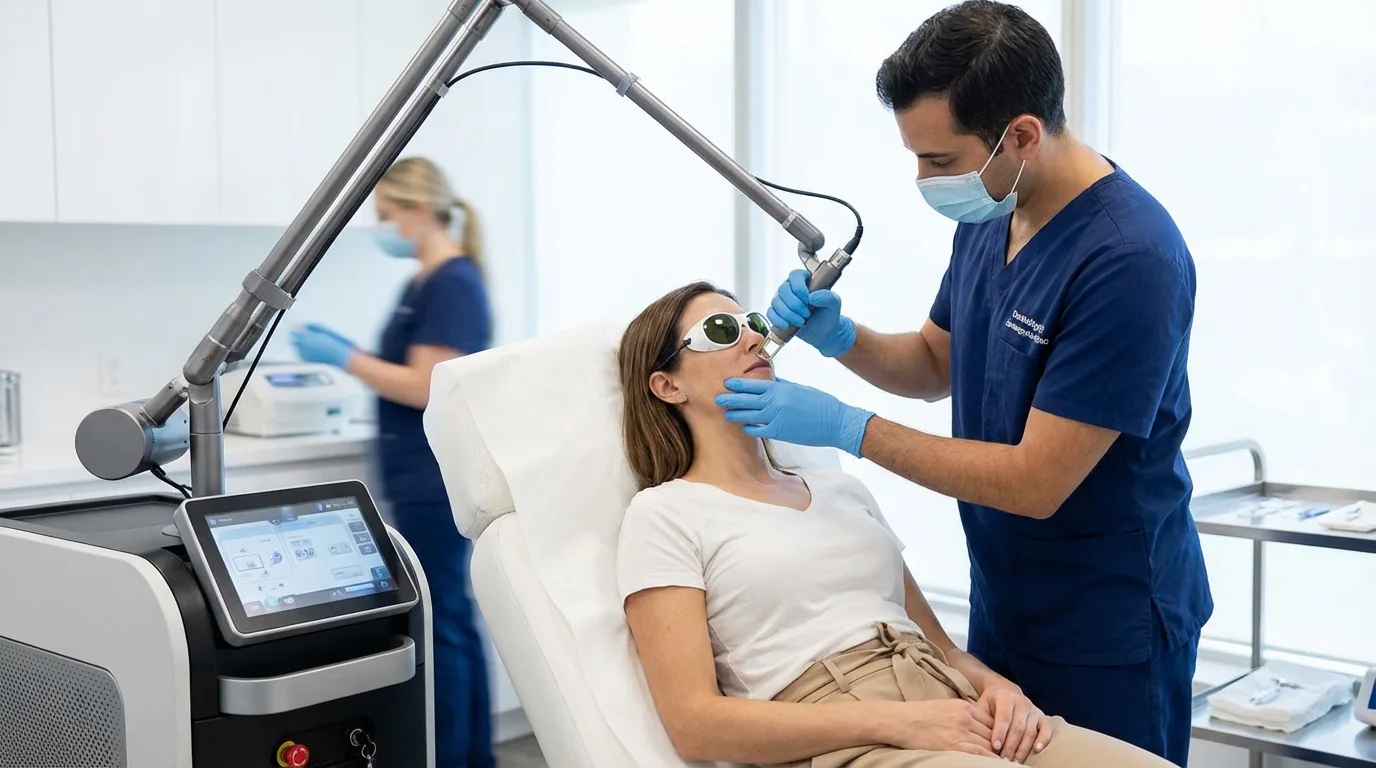
Laser resurfacing uses concentrated beams of light energy to remove damaged skin layer by layer with precision that no chemical peel or mechanical exfoliation can match. The fundamental principle is selective photothermolysis — delivering a specific wavelength of light that is preferentially absorbed by water in skin tissue, causing controlled thermal injury that triggers the body's wound healing response.
There are two primary categories: ablative and non-ablative lasers. Ablative lasers — most commonly carbon dioxide (CO2) at 10,600nm and Erbium:YAG at 2,940nm — vaporize the epidermis and part of the dermis. The thermal damage zone stimulates robust collagen remodeling during healing. Non-ablative lasers like the 1,540nm Erbium glass or 1,064nm Nd:YAG heat the dermis without destroying the surface, producing more modest results with significantly less downtime.
The introduction of fractional technology revolutionized the field. Rather than treating the entire surface, fractional lasers create thousands of microscopic treatment zones (microthermal zones) surrounded by untreated tissue. This 'islands of damage in a sea of healthy skin' approach allows rapid re-epithelialization from the surrounding untreated tissue, dramatically reducing recovery time while still achieving meaningful collagen remodeling.
Ablative vs Non-Ablative: Choosing the Right Approach
Full ablative CO2 resurfacing remains the gold standard for treating severe photodamage, deep wrinkles, and significant acne scarring. A single session can produce results equivalent to multiple non-ablative treatments. However, the trade-off is substantial: expect 7-14 days of open wounds, 2-4 weeks of intense redness, and potentially months of residual pinkness. The risk profile includes infection, scarring, and permanent pigmentary changes.
Fractional ablative lasers (like Fraxel Re:pair) offer a middle ground — treating 20-40% of the skin surface per session. Results are impressive but less dramatic than full ablative resurfacing, and recovery is reduced to about 5-7 days of significant downtime. Most patients need 1-3 sessions spaced 1-3 months apart.
Non-ablative fractional lasers (like Fraxel Re:store or Clear + Brilliant) are the gentlest option. They create tiny columns of thermal injury in the dermis while leaving the epidermis intact. Downtime is typically 1-3 days of mild swelling and redness. The trade-off is that results are incremental — most patients need 3-6 sessions for noticeable improvement, and the ceiling of results is lower than ablative approaches.
What Laser Resurfacing Can and Cannot Treat
Laser resurfacing excels at treating fine to moderate wrinkles (particularly perioral and periorbital lines), acne scarring (especially atrophic ice-pick and boxcar scars), surgical scars, sun damage including actinic keratoses, and overall skin texture and tone irregularities. For these indications, the evidence base is robust and the results can be genuinely transformative.
Where lasers fall short is in treating deep structural volume loss, active inflammatory conditions, deep nasolabial folds (which are largely a function of fat pad descent rather than skin quality), and certain types of pigmentation disorders. Melasma, for instance, can be paradoxically worsened by laser treatment because the thermal injury can stimulate melanocyte activity in predisposed individuals.
It's important to have realistic expectations about what a single treatment can accomplish. Marketing images showing dramatic before-and-after results often represent the best possible outcomes from aggressive protocols. Your results will depend on your specific skin concerns, skin type, the laser platform used, and your compliance with pre- and post-treatment protocols.
The Recovery Process
Recovery from laser resurfacing follows a predictable timeline, though the intensity varies dramatically based on the type and aggressiveness of the treatment. After ablative resurfacing, the treated skin weeps and crusts for the first 3-5 days. During this phase, keeping the skin moist and protected is paramount — many practitioners recommend occlusive ointments like Aquaphor applied continuously to prevent scab formation.
Re-epithelialization (new skin formation) typically completes within 7-10 days for fractional ablative and 10-14 days for full ablative treatments. The new skin appears pink to red and is extremely sensitive to UV exposure. Strict sun avoidance and SPF 50+ sunscreen are essential for a minimum of 3-6 months post-treatment to prevent post-inflammatory hyperpigmentation.
For post-laser antioxidant protection, a high-quality vitamin C serum is essential. SkinCeuticals CE Ferulic is the gold standard recommended by most dermatologists, available directly at skinceuticals.com. For a more budget-friendly alternative that the skincare community widely considers the closest dupe available, the Timeless 20% Vitamin C + E Ferulic Acid Serum delivers comparable actives at a fraction of the price. Your provider will guide you on when to reintroduce active ingredients — typically 4-6 weeks post-treatment.
Who Should Consider Laser Resurfacing
The ideal candidate for laser resurfacing is someone with Fitzpatrick skin types I-III (fair to light skin) who has moderate to severe photodamage, acne scarring, or skin textural concerns that have not responded adequately to topical treatments and less aggressive procedures. They should be in good overall health, non-smokers (smoking dramatically impairs wound healing), and not on isotretinoin (Accutane) within the past 6-12 months.
Patients with darker skin tones (Fitzpatrick IV-VI) are at significantly higher risk for post-inflammatory hyperpigmentation and hypopigmentation with ablative lasers. Non-ablative fractional lasers can be used more safely in these skin types, but the risk-benefit ratio must be carefully evaluated. Some newer platforms like the Nd:YAG 1,064nm laser are considered safer for darker skin tones.
If you have a history of keloid scarring, active infections in the treatment area, autoimmune conditions affecting the skin, or are pregnant/breastfeeding, laser resurfacing is contraindicated. A thorough pre-treatment consultation with a board-certified dermatologist or plastic surgeon is essential — not just a consultation with the aesthetician operating the laser.
Complementary Treatments and Maintenance
Laser resurfacing produces its best results as part of a comprehensive skin rejuvenation strategy rather than as a standalone treatment. Pre-treatment with topical retinoids for 4-6 weeks helps prime the skin for more uniform healing and can enhance collagen production during the remodeling phase. Post-treatment, a medical-grade skincare regimen maintains and extends results.
Many practitioners combine laser resurfacing with other modalities for synergistic effects. Botulinum toxin injected 2-4 weeks before perioral laser resurfacing can reduce muscle movement during healing, potentially improving results for lip lines. Dermal fillers can address volume loss that lasers cannot. Some patients and clinicians combine professional treatments with at-home LED light therapy during the recovery period to support healing and maintain results between sessions.
Maintenance treatments — typically one non-ablative fractional session every 6-12 months — can help sustain the collagen improvements achieved with the initial treatment series. Combined with daily retinoid use, antioxidant protection, and rigorous sunscreen application, the results of laser resurfacing can be maintained for years.
References
- Hruza GJ, et al. "Skin resurfacing with lasers." Clinics in Dermatology. 2002;20(3):280-285.
- Manstein D, et al. "Fractional photothermolysis: a new concept for cutaneous remodeling." Lasers in Surgery and Medicine. 2004;34(5):426-438.
- Alexiades-Armenakas MR, et al. "The spectrum of laser skin resurfacing: nonablative, fractional, and ablative." Journal of the American Academy of Dermatology. 2008;58(5):719-737.
- Ong MW, Bashir SJ. "Fractional laser resurfacing for acne scars: a review." British Journal of Dermatology. 2012;166(6):1160-1169.
Related Articles
Microneedling: How It Works and What to Realistically Expect
May 27, 2021
Botox vs. Fillers: What Actually Makes You Look Older Faster
February 14, 2024

Chemical Peels at Home vs. In-Office: An Honest Comparison
June 8, 2020
RF Microneedling: Is It Worth the Upgrade From Regular Microneedling
May 19, 2025